Monday, 2 December 2019

Copywriting Services: pay per page or per word?

copywriting services: pay per page or per word?

Freelancing and online jobs is a booming industry in some countries. It helps small and medium-sized enterprises lessen the cost of establishing a physical office for their business operation. People who are working in this type of industry are generally called Virtual Assistants.
Certain jobs such as copywriting services are one of those jobs where you can work at the comfort of your own home. It is a more specific area in virtual assistance which at times requires experience in marketing. If you are the type of person who enjoys reading or writing, copywriting is a prospective job.
If you are thinking of venturing in the Copywriting industry, and you have no idea whether to be paid per page or per word, we will help you decide by giving guidelines for copywriters. So, what does a copywriter do?
A Copywriter assists in creating printed or online marketing and it intends to promote services or products of an organization to the audience. As the famous George Gribbin said, “A copywriter should have an understanding of people, an insight into them, a sympathy toward them.” It is therefore important for you to be able to connect to your target addresses.
If you intend to do copywriting and you are new in the industry, setting the charge for your service can be tricky. Check out the difference of the mode of payments to know which one works better for you.
Pay Per Page
Advantage:
  • Allows the client and writer to get the total amount of a project easily.
  • Standard payment allows both client and writer to calculate their respective expense and earnings on the spot.
Disadvantage:
  • The amount of work needed may be different depending on the difficulty of the topic. If it requires more research, then it will take longer to complete. If payment is standard on every page, the effort of the writer may be underpaid.
Pay Per Word
Advantage:
  • It gives better earnings to a writer in contrary to pay per page charge (this depends on your charge per word)
  • It could be a better option for newbie copywriters since the charge per words are generally lower.
Disadvantage:
  • Experienced copywriters may find it difficult to get clients as the charge per word is on the upper end.
  • Clients may not be attracted to the idea of paying per word especially if they require lengthy articles or manuscripts.


Tuesday, 5 November 2019

How is Fintech Disrupting the Finance Industry?

For those who haven’t heard of fintech, it simply refers to the technology that is being used to improve functions and services within the finance industry. This has ranged from the software used by banks to improve the handling of customer accounts to super-fast money transfers and online shopping.
Indeed, whether you call it fintech disruption or improvement, here are of the ways that technology is transforming the finance industry:

Customer Service AI Bots

Chatbots are one of the most valued programmes in modern technology, particularly for financial companies. Mainly used on websites, these bots can help to handle customer queries that can be found on their website. This means that a customer won’t need to call and use the time of a human assistant to help, which means that employee can focus on trickier customer queries.
Not only does this save money for a company, but your customers have a better overall level of satisfaction as their query is answered quickly and efficiently.

AI for Fraud Detection

Although we can now access our bank and credit card accounts anywhere thanks to smartphones, that doesn’t mean that we actively check these accounts for fraudulent activity. Which means, without fintech, we won’t see fraud until our money is gone.
Many banks and financial companies are now using AI technology to flag potential fraud as it happens. Meaning both you and your bank are alerted quickly so that you can act fast to lock and re-secure your accounts.
This is not just used for fraud with customers, though, as banks themselves use this AI technology to flag and block attacks from hackers looking to mine sensitive information, which can cost those in the finance industry millions if successful.

Stronger Security Through Biometrics

As technology advances, passwords are becoming less and less safe for protecting our sensitive data. Particularly when a large majority of us use the same password for multiple websites and accounts. Which is why fintech is working on more secure ways to protect our accounts, by implementing biometrics for security. This includes thumbprints, facial recognition, vocal patterns and irises.
Many banks are rolling out biometrics to help their customers protect their accounts, particularly on smartphones that can be stolen.

The Dropping Need for Brick-and-Mortar Banks

With more people doing their banking online, through apps and websites, there has been a drop in the demand for banks to open and maintain brick-and-mortar banks. Indeed, many banks are now looking to save money by closing banks in several towns and villages.
This isn’t always met with enthusiasm though, as many rural communities with businesses are unable to conduct all their banking online. This means they will need to travel to get to a physical bank.
While some might call it fintech disruption, there is no denying that advancements in technology are helping customers and companies alike to improve security and streamline processes. Which is particularly important with online shopping and smartphones now being a normal part of society.

Monday, 21 October 2019

5 Trends of 2020 in the Language Industry


2019 is already shaping up to be an exciting year for the translation services and language industry. There are numerous great trends providing perks to the people in the know. Therefore. it doesn’t matter if you are running your own translation firm, language service provider or simply are a freelance translator, it pays to know what’s new and effective, to help you achieve continued success.
In the following post, we will discuss 5 trends that are really going to disrupt the industry throughout this year and 2020.

MTPE (Machine Translation and Post Editing)

It’s not a new thing, as it existed for more than 60 years. However, its only in the last few years that the language and translation sector has really taken note of machine translation. The main reason for the change of feeling towards it is the creation of the NMT or neural machine translation. While this system is not without its flaws, the successes the AI-based approach has had has cemented it.
As a result, there is a growing demand for post-editing machine translation service. It’s thought that by 2022, $980 billion is what the global market for machine translation is expected to achieve. If you are not yet on board with it, it may be time to do so.

Transcreation

Although it’s not as prevalent, transcreation is a growing trend. This is largely thanks to companies and organisations understanding the importance of how to approach their different clients throughout the world. Transcreation is a combination of creative writing and localisation. The concept is that in your capacity as an LSP or language professional, you adopt specific pieces of text or marketing content. As a result, it translates properly into the target language and feels as if it was created in that language.

Video & Subtitling Localisation

Of all content online, video content is the most popular. According to experts at Cisco, by 2021, 80% of all traffic online will be from videos. This has meant an increase in the demand for translation. For instance, take Facebook as a prime example. Around 85% of the video content on the platform is often played without sound, meaning subtitling is essential.
When you are involved in the translation of videos, you are often required to timestamp the original and give it to the client in the format they request. So, it’s important to understand how to use subtitling tools correctly.

Webinar & E-learning

According to Forbes, the market for e-learning will be worth $355 billion in 2025. However, as most of the e-learning content available is only created in English, there is bound to be an increase in the need for translators in this department.
Given that e-learning platforms and courses include the tech involved as well as the actual content, you need to understand not just the language, but the software used too.

Globalisation & Localisation

Thanks to the speed of the internet and the increase in its use, there is a growing need for localisation in the translation industry. Hence, content doesn’t just need to be translated straight forward. To appeal to the target audience, you really need to properly translate it.
In addition, You need translation services in singapore, Please contact us.

Monday, 23 September 2019

7 Need-To-Knows About Legal Translation


If you’ve ever read a legal document before, you’ll know how complicated and jargon-heavy they can be. Which means, when it comes to needing a legal document translated into a different language, it becomes a little more complicated than a simple language-to-language translation.
That’s because when a legal document is translated it needs to have the exact same meaning. Even something minor can result in major problems for those involved. So, before you get any legal documents translated, here are some things you should know first:

1: You Need an Experienced Legal Translator

Often, when it comes to legal translation, we believe that a translator who is fluent in the language of both the legal document and the language we would like it in is enough. However, this is far from the case, as any errors in your translation could be devastating to the persons involved.
For an accurate translation, you need someone who is also an expert in legal terminology and has vast experience in legal translation.

2: Your Translator Must Stay Up-To-Date with Legal Developments

Law is evolving and developing every day, hence, you need a translator who keeps themselves up-to-date with any changes in the law that may affect any translations. So, although you may have found a translator with legal experience, it’s important to check how recent this experience was.

3: Certain Countries Have Sworn Translators

To ensure your legal translation is undertaken by someone with both up-to-date legal experience and language fluency, you should look for a sworn translator. Hence, in certain countries, a sworn translator needs to take official exams to ensure any legal work is accurate. When they have passed their exams, they can add an official sworn stamp to that document.

4: The Difference Between Certified and Notarised Legal Translation Services

An official legal translation needs to be notarised or certified, but what is the difference between the two? Well, with a certified translation, you will receive a document that assures the translation is accurate.
If you need your translation notarised, though, you will need a certificate that states your document has been translated by a qualified legal person. For instance, a sworn translator has an official stamp as they are regulated by the government of the country that they work in.  

5: Who Needs Legal Translation Services?

People often believe that only courts will need documents legally translated. However, this is not the case, many businesses also need documents translated if they plan to expand into different countries.
People moving to other countries will also need professional translation services. This is because their important documents need to be in the language of the country that they’re applying for a visa in.

6: Types of Documents That Need Legally Translated

Depending on your circumstances, there may be a number of documents that you might need a legal translation on. For business, this can include contracts, licenses, registration documents and trademarks. Whereas, people may need legal translation services on passports, wills, adoption papers and immigration documents. 

7: Be Wary of Confidentiality

Legally translated documents are also considered confidential documents. Therefore, it’s always important to hire a reputable translation service where you know that your documents are handled safely. Using a freelancer that leaks your documents could be damaging to a business.
Overall, getting a legal document translated should always be handled by experts. Even though you save money on a cheaper translator, you may end up paying a much higher price if your document is not translated correctly.

Sunday, 28 July 2019

Competencies of Translators and Interpreters


The ability to speak more than one language is great. It’s a much-cherished talent and skill. However, translating and interpreting a language is where things get far more complicated. Languages are much more nuanced than we think. So, to translate and interpret, one requires a special set of skills; skills that are more robust than just knowing how to speak multiple languages. The core competencies of translators and interpreters are something businesses need to pay attention to.
Here is a look at a few of these competencies.

Certification/Accreditation

How are the competencies of a translator or interpreter proven?
Well, it’s obviously done through formal accreditation and certification. Your interpreter or translator should have received some kind of formal validation from a reputable institution. This is to prove that they have put in the effort to hone their skills and apply their knowledge.
Certified or accredited translators and interpreters are sure to possess an absolute grasp of a foreign language. More importantly, they are likely to be aware of other aspects such as the ethical considerations of translation and interpretation.
Finally, accredited translators and interpreters are less likely to make mistakes. Errors in such a field can lead to dire consequences. So, choose interpreters or translators that meet this requirement.
And Others.
Interpretation skills
  • - Have active listening skills and strive to improve them through self-training
  • - Have good memory retention skills
  • - Be able to take notes during the interpretation assignment to ensure accuracy of the information given
  • - Be able to mentally transpose and verbalize into the target language.


Translator skills
  • - Attention to detail, Without this quality, translators won’t consistently produce fully accurate, well-worded translations.
  • - Good organisation, Successful translators manage their time well, have good recordkeeping and are efficient in what they do.
  • - Self-motivation, The energy and discipline to do what you have to do, and go the extra mile when you need to, can only come from you.
  • - Dependability, Clients must be able to rely on you to respond promptly to communications and meet translation deadlines.
  • - Adaptability, The quality to take non-standard translation projects and unusual client requests in your stride. And to consider reviewer critiques and suggestions with an open mind.
  • - Integrity, To play by the “rules” – maintain confidentiality, observe business and professional ethics, respect your client/supplier relationships.
  • - Curiosity, Translators who are naturally curious find all texts interesting, so enjoy every translation project. And people who enjoy their work tend to do a better job.

Empathy

Translators and interpreters need to possess a wide range of interpersonal and linguistic skills. They need to be empathetic when carrying out their task of translation or interpretation. It is only when they’re empathetic that they can truly understand what’s being communicated. This helps them communicate the final message as accurately as possible.

Expertise in the Field

The core competencies of translators and interpreters don’t just end with the knowledge of multiple languages. When it comes to business localisation, they need to have industry experience too.
Your business needs to work with people that understand what’s going on and what’s at stake. For instance, an interpreter or translator for a software firm needs to be familiar with technical terms (in the necessary languages) and have an understanding of technological topics.

Conclusion

So, there you have it – the core competencies of translators and interpreters. Possessing these qualities allows translators and interpreters to go above and beyond the basic requirements. Such interpreters and translators offer capabilities that drive overall business growth.
In addition, Elite Asia provides certified interpretation services and translation services singapore.

Monday, 24 June 2019

AI Translation: Expectations Vs. Reality


AI Translation: Expectations Vs. Reality

AI technology has drastically improved due to scientists enabling computer programs to ‘self-learn’. Hence, a computer can re-program its own code in order to function better at its task at hand. Which begs the question, is AI translation set to become another norm in our lives?

What is AI Translation?

Rather than using a human translator, an AI translation will automatically translate one language into another. As a result, allowing you to comprehend what someone is saying in another language and hold a conversation with them.

AI technology can read individual words in a number of languages. It finds the similarities between the different languages that exist between words. Thereafter, building a translation!

The Advantages of AI Translation

When people hear that AI translation tools exist, they tend to expect translation tools used in sci-fi programs. Such as Doctor Who and Star Trek, where you hear people talking in your native tongue. However, this is far from reality!
Instead, the main advantages of AI translator tools in comparison to human translators is that AI is both cheaper and quicker. Here are some of the other advantages of using AI to translate languages:
  • Quality in domain- and language-specific engines is enhanced
  • Incredibly quick, normally only takes a minute or so
  • Ideal for websites
  • AI tools will let you translate a large number of languages, whereas a human may only be able to translate one or two
  • Becoming more accurate

The Disadvantages of AI Translation

Although machine translation looks good on paper, there are a number of disadvantages:
  • Accuracy can be low in some industries. (You may not realise this as you may be unfamiliar with the language)
  • Mass localisation is poor, with some languages giving more accurate results than others
  • AI does not recognise the context something is said in, so can produce confusing results
  • A language mistake can be very costly i.e. a tattoo in another language

The Reality

Many people put a lot of faith into AI translation tools because they see them as a fast and low-cost way to translate a large volume of texts. This is very common in industries such as Finance, E-Commerce, Legal etc.. AI translation may prove to be a powerful tool to achieve massive localisation. However, the accuracy of the different languages is not yet standardised.

In Conclusion

If you need something translated from another language, you should weigh up the cost of a bad translation against the cost of using a human translator. A bad translation will not only cost your turnaround to be longer but it also costs more money to resolve the mistakes!
If you’re looking to localise an e-commerce website or a large-scale portal, then AI translation is wonderful. In fact, you can leverage on a domain- and language-specific translation machines and human post-editing to translate high volume contents to targeted languages.
This encourages the user to repeatedly visit your website and may even recommend it to friends. Please see our site : translation services Singapore

Monday, 18 February 2019

Which is the Best Way to Translate Your Website, Manual File Transfer or CMS Integration?

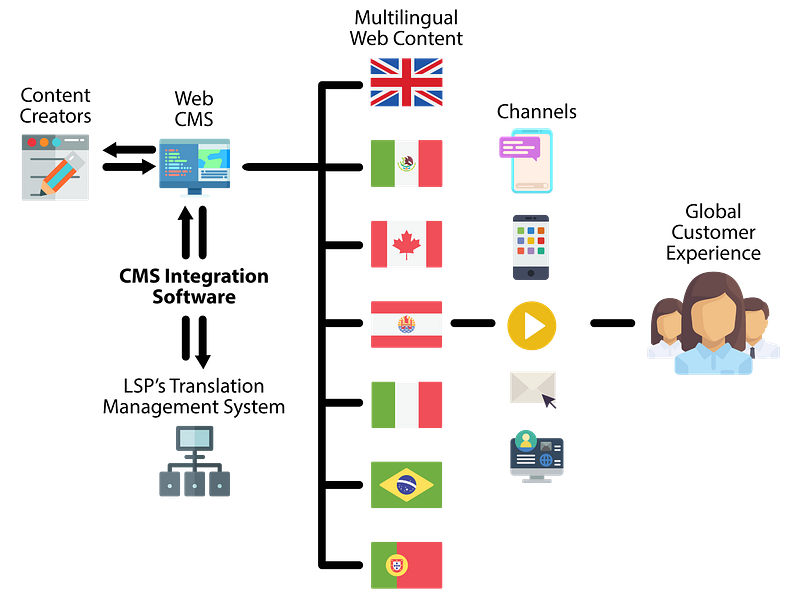
When it comes to website localisation, you have two options. The first is CMS Integration and the second one is Manual File Transfer. Let’s find out which one suits you the best.

CMS Integration

CMS integration technologies can be integrated with your CMS system to allow the selection and transfer of content to your Language Service Provider (LSP) for translation. They can streamline workflows and increase efficiency by automating source-target-language file transfers.
The technology can help automate the selection, transfer, retrieval and monitoring of content for localisation.
CMS integration is helpful for medium to large business that handles multiple multilingual websites and dynamic content. Other than that, it is highly beneficial for organizations that need constant site updates and quick time-to-market.
Environments with multiple content owners and stakeholders also benefit from CMS integration.
The approach is extremely automated and enables the development of multilingual web presences. At the same time, it also enables asset reviews and in-context layout for your in-country staff with the assistance of a staging server.
CMS integration capabilities tend to vary, which means you’ll need to do some research about making your solution secure and scalable. Avoid solutions that force you to work with a single provider/technology. This can inhibit flexibility and versatility.

Manual File Transfer

Manual File Transfer or MFT is an “outdated” approach since there is very little automation. Here, you manually transfer HTML or XML files to the LSP. The content in your database is usually exported as a CSV (Comma Separated File) or XML file.
If your CMS has no export capabilities, the file can be transferred by copying and pasting strings of code into/from Excel or Word documents.
Manual File Transfers are good for businesses that depend on homegrown CMS systems or are not dependent on automation. Homegrown here refers to systems that are built with specific functions or are extremely modified versions of mainstream CMS systems.
It can also be used for small websites translation that hold generally static content and do not require regular updates. It may also work out for businesses that need minimal localisation and are not dependent on quick time to market.
However, one key issue with MFT is that it’s time-consuming and prone to human error. Even so, small businesses that can handle the extra work may find it useful and even cost-effective compared to CMS integration.
Choosing your translation method ultimately boils down to your needs. CMS integration is the faster and smoother option, which enables users to have the fully automated translation process for websites. Meanwhile, it will prevent errors that occur when directly translating into the back-end.

Tuesday, 29 January 2019

Key Localisation Testing Processes for Websites and Software

Key Localisation Testing Processes for Websites and Software
As you might already know, localisation is the process of adapting a product, document, brand, or service to a new market.  This market can typically be described as being culturally different from the brand’s original market, with varying linguistic requirements.
To cut a long story, localisation is what you do when you want to sell your products and services to markets outside of your national or domestic markets. To penetrate such a market, you will need to translate and transcreate your content. This involves making necessary changes to your software applications and websites as well.
But, how do you know if your website or software application is up to par with local requirements? Well, that’s where localisation testing comes in. Bear in mind the cultural and linguistic rules of the target market. Localisation testing helps you determine whether or not certain aspects of your software or website conform to these rules.

The Process

The localisation testing process is determined according to the outcomes of globalisation testing. The outcome of the globalisation test can verify the functional support offered to the target market. Localisation testing is strictly carried out on the localised version of the website or application.
The testing primarily focuses on the areas that are affected by language, culture, region, UI, and content. Other than that, the localisation testing process also covers functionality, setup and upgrade tests, which are carried out in a localised environment.
Then, you also have critical business scenario tests, hardware compatibility tests, and application compatibility tests. These tests are carried out with respect to the target market.
The localisation test for linguistics and UI usually covers:
  • Linguistic accusation verification
  • Resource attributes verification
  • Application/site resources validation,
  • Typographical errors
  • Usability of UI,
  • System/input/display environment standards adherence confirmation
  • Cultural appropriateness of messages
  • Consistency checking for messages/online help/printed documentation, etc.
Politically sensitive content is deleted, and other basic parameters, such as spelling rules, date formats, video content, language, accent, sorting rules, and address formats are also checked.

The Benefits

Carrying out localisation testing helps businesses identify defects at an earlier point in time. By doing so, this can protect them from future failure or crisis. Other than that, it helps them deliver an optimized product/service right away – one that offers a unique and top-notch user experience.
The first impression is always the best one, and website localization and localisation testing ensures that businesses make the first impression. Once a business manages to impress a new market, it’s smooth sailing from that point in time. Eventually, opportunities to spread across other locations will start to show up.

Wednesday, 16 January 2019


Choosing the Right Interpreter

Choosing the Right Interpreter

Localization doesn’t always end with translation. Sometimes, you require some real-time communication, which creates the need for an interpreter. But, how do you know if the interpreter you’re choosing is worth the money you’re going to spend on them?
Well, we have a few tips to help you out.

Consider Their Qualifications

A Language Services Provider can be “judged” based on how good or bad its linguists are.  The same principle applies to interpreters. So, you need to look for someone with a perfect grasp of the language. Also, they need to be aware of and in agreement with the interpretation of the code of ethics.
Another factor to focus on is the interpreter’s area of expertise. There are interprets who specialize in various fields such as health care, medicine, and law, etc. if you need someone who can specifically speak for your industry, then an interpreter who’s worked in your area before would be a good option. In other words, it is better to choose a subject matter expert.
Also, make sure your interpreter also possesses the necessary “soft skills,” such as the ability to listen and adhere to cultural expectations.

Reputation

Reputation, at least as far as professions go, can give you a good idea of how good or bad someone is at their job. An interpreter or interpreting service that has a good reputation is obviously doing something right.
In order to check for reputation, you can request your chosen interpreter to provide a reference. You can try asking these references about the interpreter’s work and whether or not they were satisfied.

Do They Use Technology?

Technological solutions aimed at the translation and interpretation industry have developed significantly in the last few years. For instance, we have VRI or Video Remote Interpreting, which is a technology aimed specifically at interpreters.
The technology overcomes the challenges that plague in-person interpretations. For instance, the interpreter isn’t always required to be present at a particular location to help out. With VRI, interpreters can help translate at any time and from anywhere.
Other than that, you also have over-the-phone options.
The key goal is to look for an interpreter or interpretation services that offers all three options – VRI, over-the-phone, and in-person interpretation. That way, you can opt for any of the three or even all three based on your need.
Choosing an interpreter is no different from choosing a translator. The rules are still the same. You need someone with expertise, knowledge, and technological know-how to help you out. So, make sure your chosen interpreter ticks all those boxes.